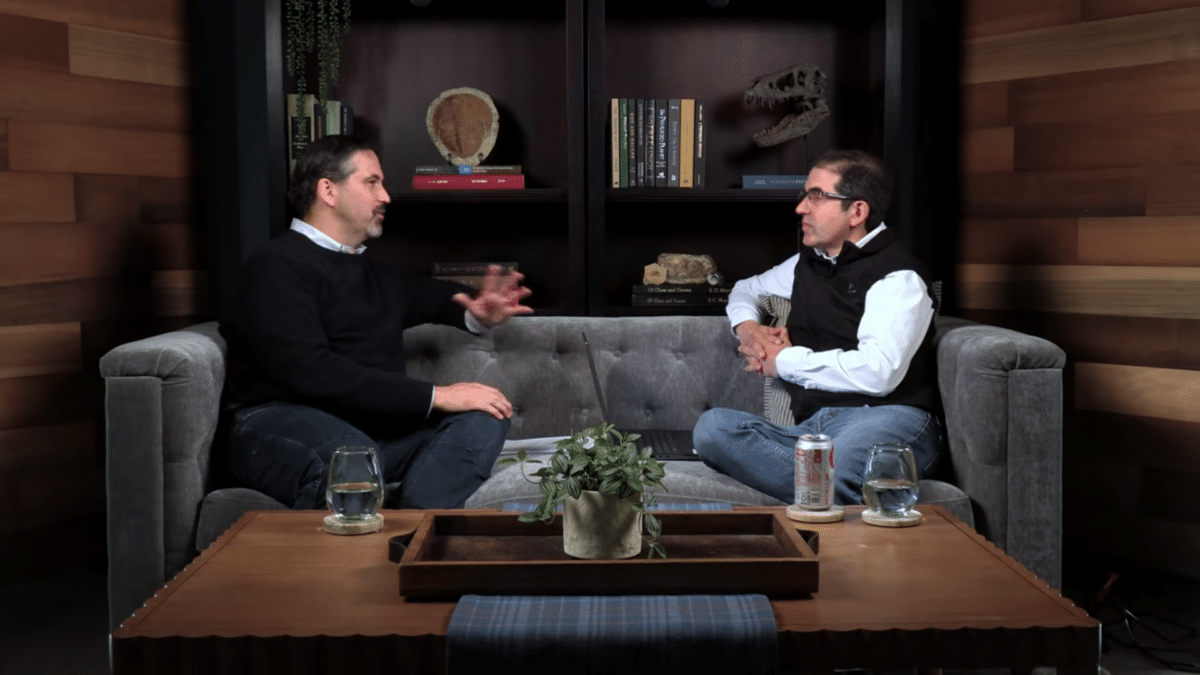

On this ID The Future, host Andrew McDiarmid welcomes astrophysicist Dr. Sarah Salviander, one of the experts featured in the new movie The Story of Everything. The movie, opening April 30, 2026 in theaters, is a cinematic exploration of the cosmos that traces the evidence for intelligent design from the precise laws that govern the stars to the intricate structures found in every living cell. Salviander recounts how her scientific research led her to question and eventually reject the atheism of her youth. She also details her experience being interviewed for the movie and reviews some of the evidence for intelligent design that she helps present in the film. Salviander was raised in a strictly secular home and had no religious background growing up. She was deeply influenced by …
Did you know the ID The Future episode archive stretches back 20 years? Chances are, you’ve missed a few! So every Friday, we pull a gem out of the vault and air it anew. On this episode of ID the Future that first aired in 2012, Casey Luskin sits down with Dr. Michael Denton, a senior fellow of Discovery Institute’s Center for Science and Culture who holds a PhD in biochemistry. Denton is the author of Evolution: A Theory in Crisis, which has been credited with influencing both Phillip Johnson and Michael Behe, as well as Nature’s Destiny: How the Laws of Biology Reveal Purpose in the Universe, which elaborates on the evidence of design in nature.
In this exchange, Luksin and Denton discuss the ways in which the universe is uniquely fit for carbon-based life, and perhaps even human life. Denton argues that when it comes to evidence of fine-tuning in the universe, the more you look, the more you find. Tune in to discover what he has found that has led him to the inference that our world is intelligently designed.
If life is built on complex molecular machines and information that is both complex AND specified, can unguided evolution actually get the credit? On this ID The Future, host Andrew McDiarmid concludes a two-part conversation with molecular biologist Dr. Douglas Axe and biochemist Dr. Michael Behe, two experts featured in the new movie The Story of Everything. Over two episodes Axe and Behe are discussing their participation in the movie and unpacking some of the insights they share in it. And you’ll enjoy more exclusive clips from the movie too!
You might find this hard to believe, but back in Charles Darwin’s day, the cell was thought of as little more than a piece of jelly. Thomas Henry Huxley called it a “simple, homogenous globule of undifferentiated protoplasm.” But today, thanks to discoveries in molecular biology, we’ve discovered the cell is something far more astonishing. And that begs a crucial question: if the cell is infinitely more than Darwin envisioned, can a Darwinian process really explain its origin, and how it came to produce the diversity we see in life?
On today’s ID The Future, host Andrew McDiarmid begins a two-part conversation with molecular biologist Dr. Douglas Axe and biochemist Dr. Michael Behe, two experts featured in the new movie The Story of Everything. Over two episodes they’ll discuss their participation in the movie and unpack some of the insights they share in it. We’re also sharing some exclusive clips from the movie!
On this episode, Mind Matters News host Dr. Robert J. Marks welcomes Dr. Mihretu Guta to discuss one of his chapters in the volume Minding the Brain titled “Mirror Neurons, Consciousness, and the Bearer Question.” Dr. Guta discusses the concept of “mirror neurons” – a type of brain cell that fires when a person observes an action being performed, as well as when the person performs the same action themselves. The properties of these neurons suggest they may play a role in empathy and understanding others’ actions. Dr. Guta explores the implications of mirror neurons to the mind-brain debate and how further study could illuminate these fascinating neural components.
By now you might have heard about The Story of Everything, the new movie based on Dr. Stephen Meyer’s book Return of the God Hypothesis. It’s a cinematic exploration of the cosmos that reveals the hidden hand behind our universe. We’re pretty excited about it, and we want you to be able to share in the excitement too! On this ID The Future, CSC Education & Outreach Director Daniel Reeves chats with physicist Dr. Brian Miller about his participation in the movie and why the film is such a powerful presentation of the evidence for intelligent design.
NASA’s recent Artemis II mission pushed the limits of human possibility with a record-breaking crewed trip to the moon. Movies like Project Hail Mary and Disclosure Day are exploring the intriguing idea of extraterrestrial life. The U.S. government promises to release a trove of UFO data in the near future. It’s a great time to be asking the big questions about the universe! On this ID The Future, host Andrew McDiarmid welcomes Eric Esau to the show to discuss his latest film, The Story of Everything, a cinematic exploration of the scientific evidence for a mind behind the universe. The film brings the arguments of Dr. Stephen Meyer’s book Return of the God Hypothesis to life through stunning footage and cutting-edge animation, as well as engaging interviews with over 20 …
On today’s classic ID the Future out of the vault, astrobiologist Guillermo Gonzalez and host Casey Luskin discuss the idea of undirected panspermia. Gonzalez explains the basic idea and what the best current evidence says about its plausibility. The occasion is his chapter on panspermia in the anthology The Comprehensive Guide to Science and Faith, co-edited by Casey Luskin, associate director of Discovery Institute’s Center for Science and Culture.
Undirected panspermia is the idea that the first life on our planet came from outer space, carried by chance processes from a faraway living planet on space dust, asteroids, or comets either from within our solar system, or from another star system to here. The idea of panspermia was inspired by the extreme difficulty of satisfactorily explaining the chance origin of life on planet Earth. Two of the idea’s earliest proponents, Gonzalez notes, were the scientists Lord Kelvin and Svante Arrhenius, each with a different take. Gonzalez argues that our increasing knowledge about the conditions of interstellar space renders the idea of life successfully hitchhiking around trillions of miles and millions of years from a faraway star system to our big blue marble unlikely in the extreme.
The Declaration of Independence is our nation’s founding creed, reminding us time and again that “we are endowed by our Creator with certain unalienable rights.” But for too long now, science has been misused to overturn the ideas found in our nation’s founding principles. Is there hope for recovering these truths anew? On this ID The Future, host Andrew McDiarmid is joined again by Dr. John West to conclude a discussion about West’s latest book Endowed By Our Creator: The Bible, Science, and the Battle for America’s Soul. This is Part 2 of a two-part conversation.
For generations, the hallowed words of the Declaration of Independence that we are endowed by a Creator with certain unalienable rights has inspired not only Americans, but millions around the globe. Yet today, many Americans are skeptical or confused about the Declaration’s key claims. On this ID The Future, host Andrew McDiarmid welcomes Dr. John West to the podcast to begin a discussion about his latest book Endowed By Our Creator: The Bible, Science, and the Battle for America’s Soul.
In Part 1, West reviews key words and phrases from the Declaration of Independence to reveal what the founders really meant by them and how they the words were shaped by the philosophical, theological, and scientific consensus of the day.